|
| Nothing better.... |
Last week was sweat equity time here in NJ as Luce’s Gluten-Free Artisan Bread moved a step closer to production. Plumbing and Electrical work had left the factory floor covered in concrete dust, which can only be removed with effort: broom-sweeping, shop-vac, finally wet mop. The Eastern US sat in a plume of tropical air, with temperature and humidity both in the mid-80’s. Ergo, every day my clothes ended up wetter than a toddler on diuretics.
 |
I’m not complaining. Physical work makes me happy. This month it has also helped move me from a place of emptiness and loss towards optimism and fulfillment. Besides, getting drenched in the afternoon reminds me of that adventuresome climb in Vermont this past July, and of the fruit story I left unfinished - at least in this my blog.
Recall the thunderstorm and the mushroom hunt, the hypothermia, the bad-judgement buying frenzy, the quarts of dead-ripe raspberries in a hotel room.... So .... picking up where I left off .....
It’s hard to imagine a more complex delight than cultivated red raspberries. Picked at the peak of ripeness, they’re a perfect balance of tender and seedy and sweet and sour, with a dusky dry exterior and pops-in-your-mouth moist interior. They are immensely fragile, which means they’re often harvested firm but unripe - a situation that makes for delightful jams and tart fillings - but they are far tastier perfectly ripe. However: woe to the picker who harvests dead-ripe raspberries carelessly. Or the consumer who buys roughly-handled fruits.
Bruised raspberries are the most mold-susceptible fruit I know, especially if they’ve been refrigerated or otherwise chilled. A moldy raspberry in my cereal leaves a lingering evil flavor, hence I carefully root out and discard every one I find, in every purchase I make.
Several berries in my Vermont harvest were white-tinged by the time I stepped from the hotel shower. I was certain that mold spores had dispersed through the lot, so there was little I could do to save them. I tried to recall why I’d bought so many, but all I could mentally reconstruct was a vague desire to have a huge bowl of crunchy granola heaped with them. But who wants granola for dinner in a foodie town like Brattleboro Vermont? OK - I could cook them. But how, in a motel room? Maybe .... Microwave???
 |
| Sugar is necessary when cooking berries |
Microwave ovens and red raspberries are two thoughts I have difficulty connecting, if only because my first moments with these fruits predate even 1960’s “radar ranges”.
My father planted raspberry vines in our rural Ohio back yard in the early 1950’s, shortly after he built our house. He must have felt about them much the way I feel about them, since they’re a crop that requires lots of labor - far more than he had to spare after coming home from a long day’s work in the steel mills. I suspect he imagined my brother and I would be eager helpers - little farmers-in-training. We weren’t. I loved eating them, but had no fondness for harvesting under the hot summer sun, or cutting back year-old stems, or training prickly new canes for the next season, or picking off the hundreds of Japanese beetles that raspberry foliage attracts.
It was my mother who waved profit-motive at me, suggesting I go around the neighborhood peddling whatever I could pick. This became my first financial enterprise. I got 30 cents a quart.
(Perspective: gasoline was 25 cents a gallon, a new house in our neighborhood ran about $8,000 and my father made $7,000 per year.)
I ended up not having to do much market development. After knocking on many doors and being rejected by all comers, I came to the winner - a woman who would buy everything I had, every time I visited. I don’t recall how many seasons this went on - at least two or three - before I decided to pursue a “real” job and leave berry-picking behind.
 |
| This was our 17th anniversary dessert |
Often I’ve wondered what that woman did with all those berries. My mother did very little with the quart or two a week I saved for home use. Her raspberry cooking can be summarized with a single word: raw. Once in a while she made jam, but the treats I’ve come to love as an adult - pies and cobblers and cake-fillings and custards - were most definitely not part of Mom’s repertoire.
Some form of cooking was required to salvage my Vermont bounty, and I had but a single instrument - a microwave. Crossing my fingers, I poured all the berries into a paper bowl, shoved it into the ‘nuke, and, guessing, zapped for two minutes. What came out was a steaming, blood-colored, seed-studded syrup. I thought, “This doesn’t look so bad,” and added several packets of sugar (thanks for the coffee bar, Hampton Inn), stirred, and headed out with Leslie to our fave Brattleboro dining spot, the Top of the Hill Grill.
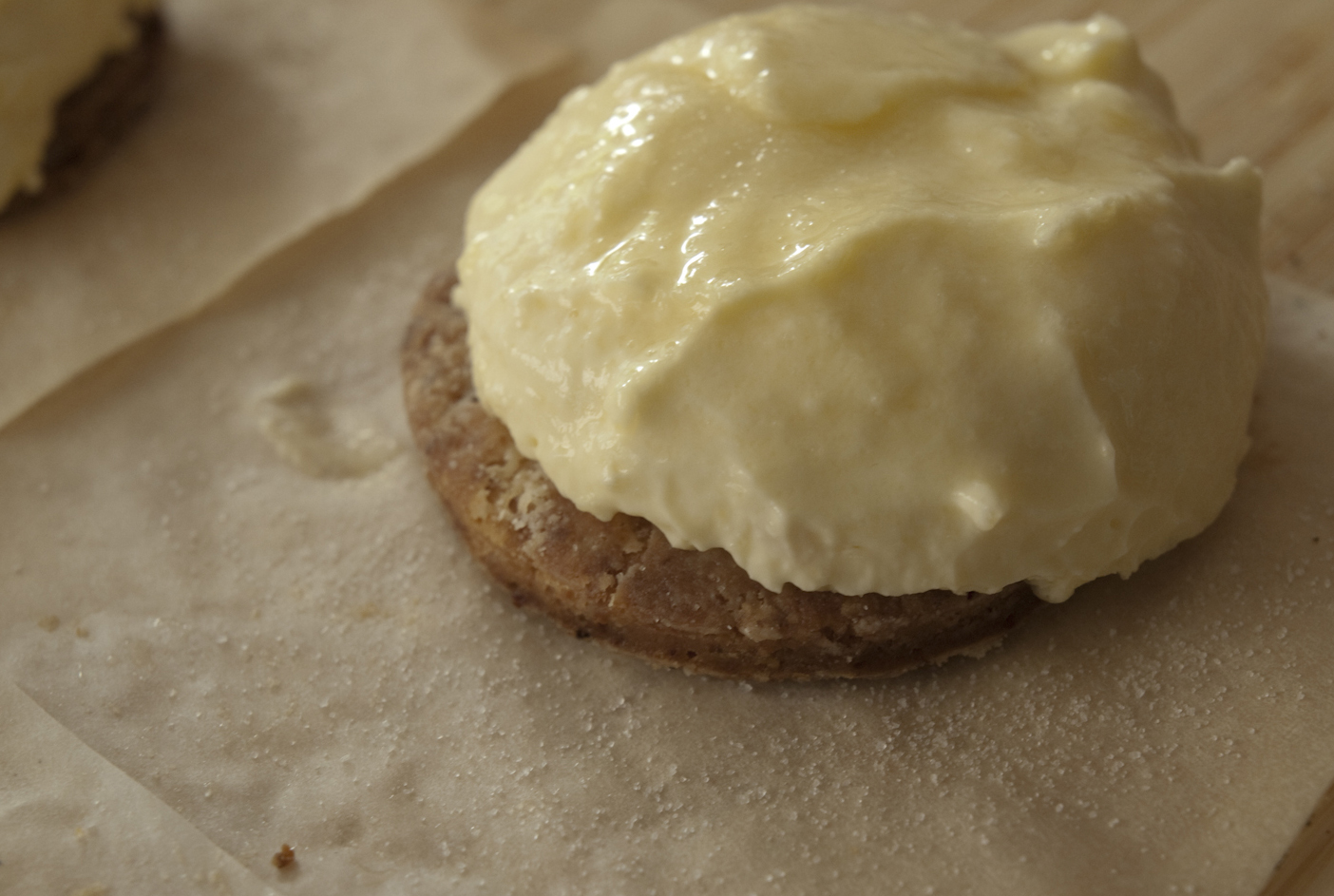
It was amazing how much like raspberry jam that paste tasted, as I discovered when we returned. Packed in a zip-lock and transported all the way home to New Jersey it still tasted good - and it lasted several days in my refrigerator while I played around with uses. A spontaneous slathering on 10% milkfat yoghurt was hands-down the easiest and richest, but it worked in muffins and on a tart as well.
The one treat I most looked forward to eluded me - but that was because I ran out of berry sauce before I got there. That treat - crepes - occupies my thoughts now as the Northeast’s fall raspberry season approaches.
 |
| Crepe ingredients. Top: Potato starch, buckwheat groats, almonds Middle: Xanthan gum Bottom: Medium egg, milk and cream Missing: sugar and salt |
Red Raspberries are interesting fruits. Some varieties produce twice a year - July and September/October. In fact they can be the last soft fruit of the season, peaking in the days just before frost.
With this in mind I’ve worked up on a crepe recipe, using buckwheat flour. Few grains have an assertive-enough taste to match up with a fruit like the raspberry, but buckwheat (not a grain, really, but an herb) does. It also makes flour that holds together with only a dab of xanthan gum.
I like to lighten my Gluten-Free crepe flours with starch (potato starch or modified tapioca starch, or a blend of the two, is best), then make the flavor more complex with nut flour. Almond complements buckwheat nicely. Also I grind my own buckwheat flour, using groats from Bob’s Red Mill and a burr grinder from King Arthur Flour. Generally I make a blend that’s 1/2 fine and 1/2 extra-coarse, so there’s interesting chew in the finished product. For the crepe recipe that follows, the amount of groats I used was so small and the number of almonds was only 4, so I decided to use my spice grinder (actually a cheap coffee grinder) instead.
Crepes are whipped up from ratioed ingredients: 1 part eggs, 1 part liquid, 1/2 part flour. Ratios are weight-based, but I’ve done a bit of conversion to help out those among you who’ve not yet sprung the 10 bucks for a kitchen scale. (I like to keep my desserts small, so I always use medium eggs.) A medium egg weighs 45 grams without the shell (about 1 and 1/2 Oz.). My crepe ratio therefore is: 1 medium egg : 45 grams (1 - 1/2 oz) milk : 22 grams (3/4 oz) flour.
 |
| Finished crepes with ingredients |
(PS: Crepes taste best if you use heavy cream blended with whole milk.)
A full recipe follows. Oh - and that elusive créme fraîche? I find it at Trader Joe’s.
Two-Bite Buckwheat Crepes with Raspberry-Créme Fraîche filling
Yield: two 8” crepes
Ingredients:
1/2 pint red raspberries
1 TBLS granulated sugar
2 tsp buckwheat groats (or about 12 grams buckwheat flour)
1 1/2 tsp potato starch
4 almonds, chopped coarse
Pinch (@ 1/16 tsp) Xanthan gum
1/2 tsp granulated sugar
Pinch salt
1 medium egg
2 TBLS Whole milk
2 TBLS heavy cream
4 TBLS créme fraîche or whipped cream
+/- 1 tsp unsalted butter, for griddle
Procedure:
Set aside 8 - 10 of the raspberries. Taste one. Smile.
Place the remaining raspberries in a microwave-proof bowl. Sprinkle with the 1 TBLS granulated sugar. Microwave on high for 1 minute 15 seconds, or until berries are reduced and beginning to foam. Stir, and set aside to cool.
Chop almonds coarsely. Put almonds and groats in a spice grinder and run until blend is smooth, stopping occasionally to scrape any flour that sticks to sides. Add potato starch, sugar, xanthan gum and salt, and pulse to blend. Pour into medium bowl.
Add milk, cream and egg to flour. Whisk until very smooth.
Heat a crepe pan or griddle to medium high. Melt a thin layer of butter in pan, then ladle 1/2 the batter into pan. Immediately swirl the pan to spread the batter thin and wide. Allow to cook until crepe has just turned dry all over, then flip and cook other side. Set aside on tin foil or a plate. Cook second crepe.
Smear each crepe with 2 TBLS of créme fraîche. Divide cooked berries between crepes. Roll crepes and dust with confectioner’s sugar (optional). Decorate with the reserved berries and serve immediately.